Look less. See the bigger picture.
Start a round with the last reported position. GPS fix time and report receipt time are shown separately.
Livestock & pasture · a clearer view between visits
You cannot be everywhere on the farm. Get a calmer basis for where animals last reported, when a collar checked in, and what may need checking.
An application in QuickIoT · extend with shared modules
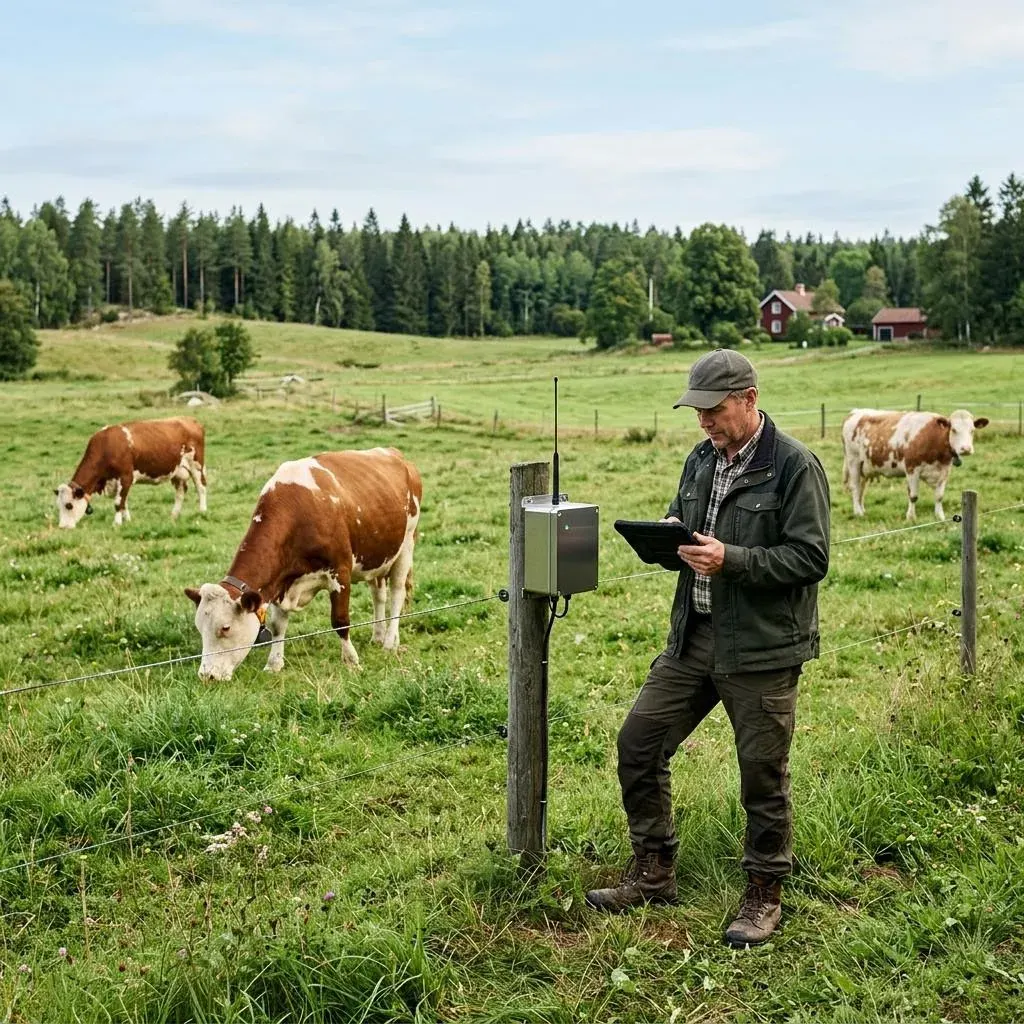
Start a round with the last reported position. GPS fix time and report receipt time are shown separately.
Collars can report through a shared farm Vital station, within coverage that must be tested on site.
Water and environmental measurements can be explored later. A drone module is planned, not installed or cleared for flight.
Vital-station · expand when useful
A shared node can use existing farm internet where suitable or a shared mobile connection. These options are proposals, not evidence of installed or activated hardware.
Last position, movement indication and contact.
Water and environmental sensors as possible later options.
A planned inspection module, subject to separate checks.
Proposed customer view · example
Select an animal and a fixed synthetic scenario. Collar contact never changes the GPS fix time.
Trial pasture
Schematic pasture. No real coordinates or positions.
Fixed synthetic reference time · Europe/Stockholm: 2026-11-04 11:15 CET.
Animal: DJ-001 · Collar: HB-1842
GPS fix 2026-11-04 11:12 CET; packet received 2026-11-04 11:14 CET; station last contact 2026-11-04 11:14 CET. These are separate times.
Sensor not installed. Neck temperature is an optional trial, not body temperature or a fever assessment. Movement is a sensor indication, not a behaviour or health diagnosis.
Neck temperature is an optional trial, not body temperature or a fever assessment. Movement is a sensor indication, not a behaviour or health diagnosis.
Local preview only · no storage, API, notification or device activation.
Station setup · proposal only
Choose what would be useful on your farm. We will discuss a suitable first setup together. These selections do not order or activate anything.
See where animals last reported and when the readings were taken. The overview complements the keeper’s visits and judgement; it does not replace them.
For a farm exploring a clearer view of one pasture. Start with a responsible keeper, a proposed station location and up to three collars.
Scope the need and choose equipment for a bench trial. Follow with a coverage trial and, only after joint review, a supervised animal trial.
Together we review what suits the animals and the site. Fit, battery, coverage and practical daily checks need to be tried before you move forward.
The pilot should document report timing, GPS-fix rate, contact outages, coverage gaps and actual energy use. This synthetic demo provides no field evidence.
The keeper and QuickIoT review the trial and decide whether to relocate the station, change equipment, add collars or wait. Options are selected separately.
Set acceptance criteria before the field trial. Follow fit and rubbing, charging work, unnecessary alerts, time to find animals and total farm cost — without guaranteed savings or health claims.
A simple way to begin
Start small and supervised. Expand only after fit, coverage, data and usefulness have been checked on the farm.
Test technology and fit on the bench. Verify physical model, CE evidence for the exact final product, battery, mounting and sensors.
Walk the chosen pasture and station location. Document radio coverage and internet path; station count is determined on site.
Start with one supervised animal, review, then expand to at most three only if safety and value support it.
Discuss a small, bounded first assignment within QuickIoT.